
Criminal Court Cases in Hartford
Hartford has no county clerk and no municipal criminal court. The Connecticut Superior Court keeps the criminal dockets. At 101 Lafayette Street, the Hartford Judicial District handles the more serious stream, largely class A and B felonies from 19 communities. Geographical Area No. 14, at the same address, is the usual Part B route for Hartford's lower felonies, misdemeanors, infractions, and motor-vehicle matters. Transfer and offense rules can move a case between those streams.
Hartford Community Court at 80 Washington Street uses a problem-solving model for quality-of-life matters. It is still part of the state court structure, not a city archive. The criminal clerk at Lafayette Street is the custodian to contact for docket questions, copies, certification, and older material. HPD can provide its own report, but it cannot certify a court disposition.
| Hartford office | Role | Contact |
|---|---|---|
| Superior Court criminal/JD | Serious felony and transferred files | 101 Lafayette St.; 860-566-1630 |
| GA No. 14 | Lower felony, misdemeanor, infraction, motor vehicle | 101 Lafayette St.; 860-566-1630 |
| Community Court | Problem-solving quality-of-life docket | 80 Washington St.; 860-756-7840 |
Choosing a Hartford Court Search
The Connecticut Judicial Branch Criminal / Motor Vehicle Case Look-up separates questions that sound alike. The conviction route looks for decided convictions, the pending route looks for open public cases, and the daily docket finds scheduled appearances by court or defendant. An attorney or firm can also search by juris number. Pick the mode that fits the question before entering a name.
A conviction-only result cannot rule out a pending Hartford prosecution. Likewise, the daily docket is a calendar, not a complete history. The portal is free and needs no login, but a common name is not proof of identity. Compare the court, docket, birth year when shown, and known case facts.
The official Hartford court-list screen shows how the Judicial Branch organizes local access.
Use that official court context to distinguish Lafayette Street criminal matters from other Hartford Judicial Branch locations.
Hartford Court Case Record Searches
Start online for a public index, but keep the clerk as the fallback. The Judicial Branch says conviction information generally remains online no more than ten years after sentencing and may be removed sooner under its rules. Juvenile, youthful-offender, infraction, and violation convictions are not displayed. Erasures, pardons, and corrections can also change public data each day.
- Open the criminal lookup and choose conviction, pending case, or daily docket.
- Search the legal name, and use birth year where offered; try a known former name separately.
- Use the exact docket route when a complete Judicial Branch docket number is known.
- Open the detail and compare court, status, charges, disposition, sentence, and next event.
- For an old file or missing document, call 860-566-1630 or visit the first-floor Public Information Desk at 101 Lafayette Street; state whether a plain or certified copy is needed.
| Search field | Type | Use | Notes |
|---|---|---|---|
| Last name | Text | Name searches | Use legal spelling |
| First name | Text | Name searches | Portal behavior varies by mode |
| Birth year | Number/select | Narrowing | Helps separate like names where shown |
| Court location | Select | Daily docket | Choose Hartford or GA No. 14 as appropriate |
| Docket number | Text | Exact case | Enter the complete identifier |
Hartford's Lafayette Street Desk
The first-floor Public Information Desk at 101 Lafayette Street is more than a directions counter. It provides calendar and docket information, electronic case lookup, forms, publications, program information, a public-access computer, a public telephone, language help, notary service, and staff assistance. It is the practical next stop when the public screen omits an older disposition or a user cannot identify the right docket.
For an offline request, give the docket number if possible, defendant name, desired document title or date, copy type, and preferred format. Archived material may need retrieval. The research did not establish a current copy or certification fee, so confirm cost with the clerk instead of relying on an old fee list.
The Judicial Branch describes the Hartford Public Information Desk and its courthouse services on the official desk page.
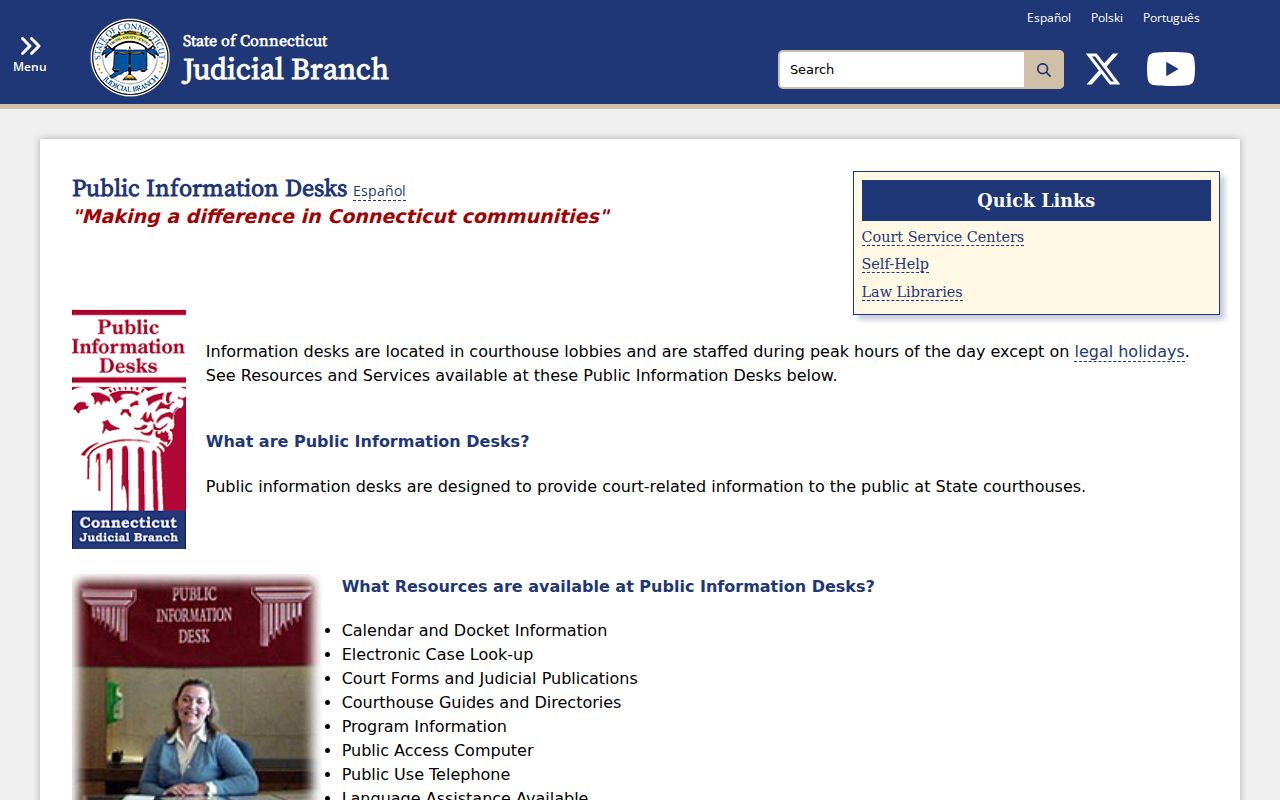
That staffed access point matters because the website is an index with limits, not a promise that every pleading or exhibit can be downloaded.
What a Criminal Case File Contains
A Hartford docket is organized around one court case. It can show how filed charges changed and how each count ended. The useful fields are the docket number, court, status, arrest and offense dates, statute and charge description, plea, charge-level disposition, sentence, bond, lawyer appearance, next event, and transfer information. The underlying file may also contain the charging instrument, motions, orders, and other available documents.
| Case number and court | The unique docket and the Hartford location responsible for it. |
|---|---|
| Charging record | The prosecutor's filed allegation, which may differ from the booking charge. |
| Docket entries | A dated event list for appearances, filings, rulings, and transfers. |
| Plea and hearing dates | The plea shown by the court and scheduled or completed events. |
| Disposition | The result for each charge, such as conviction, dismissal, nolle, or acquittal. |
| Sentence and conditions | Incarceration, suspended execution, probation, fine, restitution, or other terms when public. |
A portal screen is not automatically a certified record. If an official copy is needed, ask the clerk which judgment or disposition document answers the question. The broader Hartford criminal history overview explains how a docket differs from HPD, SPBI, and DOC records.
Hartford Booking Charges Can Change
An arresting officer records suspected offenses at booking. The prosecutor can later add, reduce, replace, or decline charges based on the evidence and legal review. This is why an HPD arrest-log label should not be carried forward as though it were the court's final finding. The filed docket, then the charge-level disposition, is the sounder source.
Connecticut terms matter. A conviction is a guilty finding or accepted guilty or nolo plea that has not been erased. A dismissal ends a charge. An acquittal is a not-guilty determination. A nolle prosequi means the prosecutor has chosen not to pursue the charge at that time, with Connecticut's erasure timing then becoming important. Those results are not synonyms.
Note: Read every count separately because one Hartford case may contain both convictions and charges that ended without conviction.
Criminal Case Stages in Hartford
A Hartford matter often begins with an arrest or summons, but the court record becomes authoritative for the prosecution once charges are filed. Arraignment addresses the allegations, rights, plea, and bond. Pretrial work can include disclosure, conferences, motions, and probable-cause proceedings where required. A plea can resolve the case; otherwise it can proceed to trial. Disposition records the result, and sentencing states the consequence after a conviction.
Case flow: Charges Filed › Arraignment › Pretrial › Plea or Trial › Disposition › Sentencing
An appeal or later erasure can alter what remains publicly visible. Timing also explains why a very recent arrest may appear in an HPD log or DOC search before the Judicial Branch has indexed a case.
Older Hartford Criminal Dockets
No online result is not a reliable statement that no Hartford case ever existed. The ten-year online conviction window, Practice Book removal, erasure, juvenile and youthful-offender exclusions, spelling, and archive status can all explain a blank result. Confirm that the correct search mode and Hartford location were used before drawing a conclusion.
For an older public file, call the clerk or use the Lafayette Street desk. Ask whether the docket is archived and what details are needed for retrieval. A precise request is more useful than asking for everything about a person. Give the docket, name, date range, and a document description, and distinguish an ordinary copy from a certified one.
Certified Hartford Copies and Screens
A portal result is useful for locating and reading a Hartford docket, but it is not the same product as a copy certified by the clerk. The online view can change after a correction, erasure, pardon, transfer, or later court event. It may also summarize the docket without supplying the charging paper, judgment, motion, or order that answers a precise records question.
Ask the Lafayette Street clerk what document records the required fact and whether a plain or certified copy is appropriate. Supply the full docket number, defendant name, document title or approximate filing date, and preferred format. If the file is archived, allow for retrieval rather than expecting an immediate download. The accessible official research did not establish a current Hartford certification charge, so obtain the live price before sending payment.
Certification confirms that a copy comes from the court record; it does not turn every allegation in the file into a finding. Read the disposition and sentence entries alongside the charge, and check whether separate counts ended in different ways.
Access Rules for Case Records
Public access does not make every part of a Hartford criminal file open. Juvenile and youthful-offender cases, erased charges, victim identifiers, Social Security numbers, full birth dates, protected witness material, sealed filings, and some exhibits remain restricted or redacted. The public portal also does not promise document images for every docket.
Connecticut's access rules include CGS §1-210 on public agency records, CGS §54-142a on erasure, and CGS §54-142k on conviction and criminal-history disclosure. Court access follows Judicial Branch rules; a municipal FOIA request to HPD does not compel the court clerk to release a protected court filing.